
Schwarzlot (German: schwarz – dark, black; German: löten – to melt, to solder) is a black paint made from copper or iron oxides. It was used for painting as far back as the Middle Ages. Stained glass artists used schwarzlot to draw fine details in their works – facial features, curls of hair, folds of clothing, and inscriptions.
To make Schwarzlot, copper oxide had to be mixed with glass powder and oil. Artists applied the resulting paint to pieces of colored glass using a pen or brush. After firing, the paint fused with the glass surface.

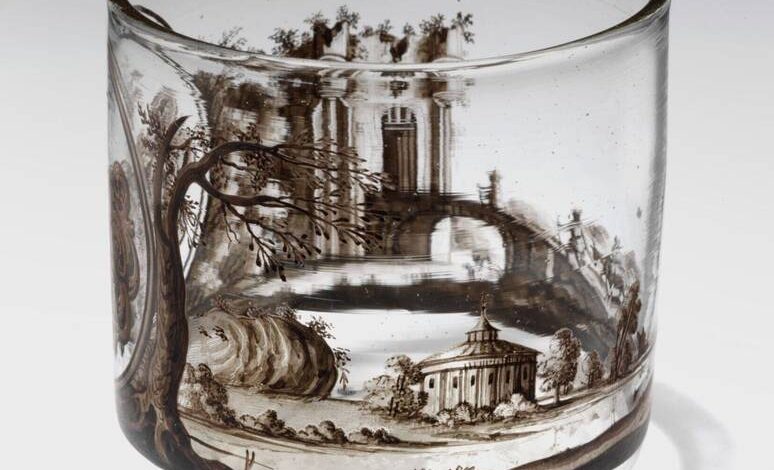
A glass with black glaze painting. Height: 7.6 cm. Artist: Johann Schaper. Nuremberg, circa 1655.


A glass with black enamel and colored paint. Height: 10.2 cm. Artist: Johann Schaper. Nuremberg, 1664.
metmuseum.org
During the Baroque era, the German artist Johann Schaper perfected the technique of blacksmithing, adapting it for decorating glass and earthenware. Thanks to his talent and skill, blacksmithing became popular among aristocrats and the wealthy.
Johann Schaper ( 1621–1670 ) was born in Hamburg. Little is known about his life. According to historical documents, he traveled through the Netherlands and Switzerland before settling in Nuremberg in 1655, where he lived until his early death in 1670.

A faience plate with colored painting. Artist: Johann Schaper. Nuremberg, mid-17th century. Collection of the Museum of Applied Arts in Cologne.
rare-ceramics.com


Delftware jug. Height: 22.6 cm. Artist: Johann Schaper. Nuremberg, circa 1660–65.
rare-ceramics.com
Schaper worked as a “Hausmaler”—an independent artist who decorated glass and faience pieces for private commissions. He signed his works with his full name or the initials “JS,” emphasizing his unique approach and distinguishing him from other artists of the time.
 metmuseum.org / bonhams.com
Johann Schaper specialized in painting cylindrical glass tumblers. They could be mounted on three or four spherical stems. These pieces became known as “Schaper glasses” (German: Schaper-Glas ). It’s worth noting that in addition to glasses, the artist also painted plates, bowls, and goblets. He used black enamel and colored enamel in his work.
Schaper’s works are distinguished by their high level of detail and mastery of perspective.
Schaper’s works are distinguished by their high level of detail and mastery of perspective.

A glass painted with colored enamel. Height: 6.6 cm. Artist: Johann Schaper. Nuremberg, 1670.
imkinsky.com


A glass with a lid, decorated with black slate painting. Artist: Johann Schaper. Nuremberg, 1668.
collections.vam.ac.uk
 A mug with a lid, decorated with blacksmith’s gilding. Earthenware, silver with gilding. Height – 18 cm. Artist: Johann Schaper. Nuremberg, 1663.
rare-ceramics.com
Main motifs of Johann Schaper’s works
Main motifs of Johann Schaper’s works
- Landscapes with ruins inspired by engravings of French, German and Italian artists;
- Hunting scenes, including images of hunters, animals and landscapes with castles in the distance;
- Biblical and mythological stories;
- Characters of the Italian commedia dell’arte;
- Military scenes. For example, depictions of battles and city sieges.
Johann Schaper made a significant contribution to the development of decorative art in the 17th century. His works on glass and faience became a model for subsequent generations of artists, such as Ignaz Preisler and Anton Kothgasser, who continued to use black glass in the 18th century.
Today, most of Shaper’s works are kept in the collections of major museums around the world.

A glass painted with black glaze. Height: 7.1 cm. Artist: Johann Schaper. Nuremberg, mid-17th century.
samlingar.shm.se

A glass painted with black glaze. Attributed to Johann Schaper. Nuremberg, mid-17th century.
clevelandart.org

A glass painted with black glaze. Height: 6 cm. Artist: Johann Schaper. Nuremberg, circa 1670.
collections.vam.ac.uk


A mug with a lid, decorated with black glaze painting. Earthenware, lead glaze, gilded metal. Height – 22.2 cm. Artist: Johann Schaper. Nuremberg, circa 1663.
collections.vam.ac.uk


 Painted glass tumbler. 10.2 x 8.7 cm. Work by Johann Schaper, a German glass and faience artist. He was so renowned that his technique was called “Schaper glass.”
Nuremberg, Germany, 1664.
Sources:
metmuseum.org
collections.vam.ac.uk
rare-ceramics.com
de.wikipedia.org
bonhams.com