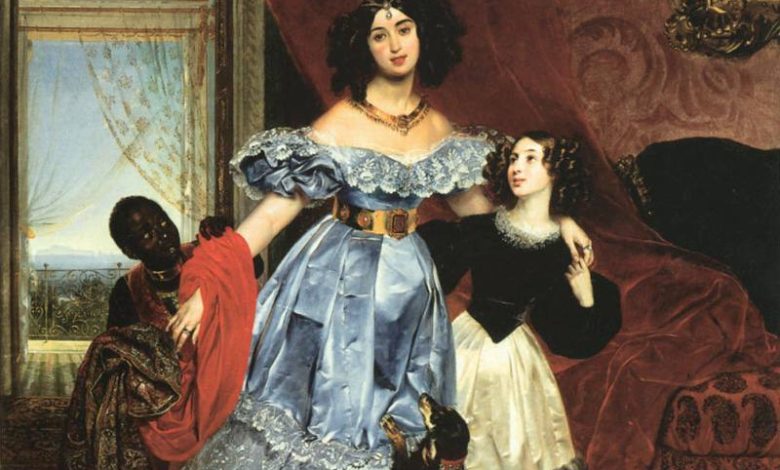
The Countess and the Artist Karl Bryullov. Portrait of Yulia Samoilova (Bryullov’s very fatal love) with Giovanina Pacini and a Black boy. 1832-1834
  Karl Bryullov. Horsewoman. 1832
Bryullov’s “Horsewoman” and the artist’s mistakes
First, a little about one of the most famous and beloved works. And the artist’s mistakes.
The painting was completed in 1832. Karl Bryullov, or “The Great Karl,” as he called himself, was one of the first in Russian art to depict a woman on horseback.
Generals were usually depicted on horseback in battle scenes, but here we see a young girl in a side-saddle.
Who is this girl?
A ward (in other words, adopted daughter) of Countess Yulia Samoilova, the countess and the artist’s lover.
The plot is simple and clear: a girl is returning home from a horseback ride, as a thunderstorm is beginning.
But!
Is everything in this painting as “smooth” as it seems at first glance?
Look at the landscape in the background—see how the trees bend in the strong gusts of wind?
Yet the girl herself (and her clothes) seem completely unaffected by the weather.
The horse she sits on so effortlessly seems not to be alive (look closely). Yes, it was painted by Bryullov from a porcelain figurine.
What other “mistakes” are there?
The girl sits surprisingly easily in the side-saddle when the horse rears. And she even maintains a calm expression.
And the dog!
It seems as if it is not standing on the ground, but hovering above it.
And notice the collar on the little dog. It says “Samoilova” on it.
What a revelation of a famous painting!
The connection between Countess Yulia Samoilova, a captivating beauty of the first half of the 19th century, and Karl Bryullov, the very same author of “The Horsewoman” and “The Last Day of Pompeii.”
Let’s start, perhaps, with the Countess’s origins. Her life was nothing but a celebration and fireworks display. And it had been that way since birth.
Most likely, the future femme fatale’s mother (her name was Maria) had a daughter with an Italian, Giulio Litt, who later called himself Julia’s adoptive grandfather.
Confused by the phrase “adopted grandfather”?
Me too… and “grandfather” because the Italian, Giulio, was the stepfather of Maria’s husband, General Pahlen!
So, Maria, Julia’s mother, most likely had an affair with her husband’s stepfather.
After Julia’s birth, the general demanded a divorce; apparently, the Italian traits in the girl were immediately noticeable. The mother didn’t want to see the girl, as she reminded her of her failed marriage… or of her strange affair with her husband’s stepfather…
So, Julia was raised by her “adopted grandfather” (or father?!) and grandmother, and, it must be said, they raised her in luxury. Karl Bryullov. Odalisque. 1835
Julia, then still Pahlen, was presented to court at a young age. With her Italian features, striking southern good looks, and chiseled figure, she immediately captivated everyone. Especially the Emperor! Alexander I was reigning at the time. A handsome, tall, blond man, a womanizer… there’s speculation that the young woman became not only a lady-in-waiting but also the Emperor’s mistress.  Samoilova. Artist B.-Sh. Mituar, 1825 (and she really is beautiful!)
Incidentally, Julia would never be able to bear children…
Perhaps this is because, in her youth, the Countess’s pregnancies with the Emperor were handled by court physicians, you know how.
Favorites tend to enjoy attention for only a short time… so, when Alexander I’s interest waned, he decided to marry off his no-longer-love interest. And the man the Emperor himself chose for Julia was Nikolai Samoilov.
Was Nikolai in favor? No. Well, no one asked him. Yulia married him, and from then on she became Samoylova.
The marriage was anything but happy. Nikolai gambled and squandered the money he’d received as a dowry from his wealthy but tainted (I think you understand…) bride, paying no attention to his young wife.
Their life together was so unhappy that Yulia and Nikolai were even officially divorced! And that was a rarity for the early 19th century. And the rest of Samoylova’s dowry was returned.
That’s where it all began. A free, beautiful, rich, divorced femme fatale, in a word!  Karl Bryullov. Turkish. 1837-1839.
And here Samoylova’s features are recognizable.
Where did the future lovers—the artist Bryullov and the socialite Samoylova—meet?
In a salon! Not in Russia, but in Italy.
A salon is a kind of 19th-century “hobby club.” There they discussed art, literature, history, read poetry, listened to music… in short, the powers that be spent their leisure time in a cultured manner.
So… That’s where they met. And both were somewhat “tarnished.” It was said that because of Bryullov, a young woman drowned herself in the Tiber, and because of Samoylova, a cornet shot himself. All because of unrequited love, of course!
Incidentally, Karl Bryullov even tried to justify himself in high society, saying he had no idea about his feelings… and what about Yulia Samoylova? And what did she care who shot themselves or why? She was above it.
Well, as you can imagine, they were both quite the characters.  Self-portrait by Karl Bryullov, 1833:
Bryullov called himself “The Great Karl” (modestly, however) and craved admiration for himself and his talent; Countess Samoilova also adored basking in compliments and admiration. But, it must be said, she had a right to. Actually, they both did.
Just read what Gogol wrote about her:
“She is not Raphael’s woman, with delicate, subtle, angelic features—she is a passionate, sparkling, southern, Italian woman in all the beauty of midday, powerful, strong, ablaze with all the luxury of passion, all the power of beauty—beautiful as a woman.”
It is not surprising that Bryullov, who adored beauty, immediately lost his head upon seeing Samoilova.  “The Last Day of Pompeii.”
“My dear Briška… I love you more than I can explain, I embrace you, and until the grave I will be spiritually devoted to you” —this is how Yulia Samoilova addressed her beloved artist. He, therefore, called himself “The Great Karl,” and she called him “Brishka.”
Their rapprochement developed slowly, like the birth of a masterpiece. He taught her to see colors where others saw only colors. She showed him the high society of which he knew only by hearsay. The difference in their status seemed to only add a special piquancy to their relationship.
“You know, Briška,” she said once, calling him by this affectionate nickname for the first time, “there’s something of the ancient gods in you. The same detachment from worldly vanity.
” “And in you, Countess, there’s something of the Roman empresses. The same ability to command hearts.
” “And the same ability to break them?” she smirked, hinting at her reputation as a femme fatale.
“No, the ability to transform them into works of art.”
High society watched their romance with avid interest. Of course! The first beauty of Rome and an artist, albeit a genius, but still a commoner. Gossips predicted the imminent collapse of this relationship, cynics bet on who would cool off first, romantics sighed for the triumph of true love over prejudice.
But overall, their relationship, so bright and quick to develop, greatly shocked high society.
Why?
Because it was free! Bryullov would sometimes leave Italy for St. Petersburg. During these times, Samoilova would write him letters like these:
“Tell me, where do you live and whom do you love?…”
She herself didn’t miss him very much…
But that’s not the main thing… the main thing is that Yulia Samoilova became Karl Bryullov’s muse for many years.
What is the artist’s most famous work?
Of course, “The Last Day of Pompeii.” The artist worked on it precisely during the height of their relationship, from 1830 to 1833.
Is it any wonder that Countess Yulia is depicted in the painting not once, or even twice, but three times?  A woman with a jug on her head, a woman holding a baby in her arms, and a woman embracing her daughters—all of them are Countess Samoilova.
Incidentally, Bryullov couldn’t deny himself the pleasure of being depicted in a historical painting alongside his beloved, to remain with her for centuries, so to speak. That’s why, to the left of the lady with the jug, we see a man with a box on his head. The box contains brushes and paints. This is the very same Karl Bryullov.
The winter of 1833 was unusually warm in Rome. Roses were still blooming in the gardens, and in the evenings, the spicy scent of orange trees drifted through the open windows of the palaces. Bryullov worked on “The Last Day of Pompeii” locked in his vast studio on Via San Claudio.
Julia came to him every day, bringing with her a wind of change and the scent of French perfume. She would settle into an old armchair, wrapped in a black shawl, and watch the artist at work. Sometimes she would fall asleep to the rustle of his brushes, and then Bryullov would furtively sketch her sleeping face.
“Brishka,” she said one day, examining a nearly finished canvas, “why do all the women in your painting look like me?”
— Because I see you even with my eyes closed.
— Even that unfortunate woman who falls dead in the center of the painting?
— Especially her. Every tragedy must have its fatal beauty.
Julia laughed, but there was a note of anxiety in her laughter. It was as if she had a premonition that this painting would change their lives forever.
“The Last Day of Pompeii” was a sensation. Italians carried Bryullov in their arms, showered him with flowers, composed sonnets in his honor. Newspapers called him “the new Raphael.” And Emperor Nicholas I sent an order for the artist to return to St. Petersburg.
“I don’t want you to go,” Julia begged.
“This is your home, your glory, your freedom.
” “And you?” he asked, looking into her eyes.
“I will find you anywhere. Even in the snows of St. Petersburg.”
But they both understood that this was not true. In Russia, they would have to play by different rules. There, Countess Samoilova isn’t just a rich, quirky beauty, but the granddaughter of a relative of Empress Catherine I. And he’s just an artist, albeit a brilliant one.  Karl Bryullov. Portrait of Countess Samoilova Leaving a Ball with Her Adopted Daughter Amazilia. 1842.
How did their flamboyant love end?
Bryullov was greeted warmly in St. Petersburg. Honors, commissions, the title of court painter, and a gilded cage of obligations awaited him. In the classrooms of the Academy of Arts, he taught young talents the basics of artistry, but in his heart he yearned for the freedom of Rome and his wayward muse.
Yulia kept her promise and came to the capital. But this was a different Samoylova, ensnared in the corset of social conventions, surrounded by a swarm of admirers and envious people. In public, they barely exchanged greetings, but her portrait in the artist’s studio grew ever more detailed.
Before leaving, he began painting her portrait, the very one where she leaves the ball. Perhaps he already sensed then that she was leaving his life? One day, while posing for Bryullov, she said:
“Paint a red curtain behind me, Brishka. As scarlet as the sunset over Rome.
” “Why?” You always said you didn’t like the color red.
“Because it’s like blood. The blood that flows in my veins and keeps me from being like everyone else.”
Her voice was tinged with bitterness. Recently, Emperor Nicholas I had pointedly turned away from her at a ball, hinting at the Countess’s inappropriate behavior. And the next day, the whole world was discussing her latest scandalous affair.
Bryullov painted the red curtain with fury, as if trying to pour out all his jealousy and pain onto the canvas. He knew about her infatuations, just as she knew about his affairs, but they never reproached each other. They had their own morals, their own code of honor.
That year, Petersburg was swept by a wave of gossip. They said the artist had become an alcoholic, that the Countess had gone bankrupt, that their secret affair was still ongoing. But they were simply trying to live, each in their own way, each in their own cage.
The denouement came at the Persian ambassador’s ball. Yulia resplendent in the very dress Bryullov loved so much. She danced, laughed, and charmed the diplomats with her French lilt. And then, in the middle of another waltz, she stopped abruptly.
“I’m stuffy,” she said to her escort. “I’m leaving.”
She headed quickly for the exit, throwing on a fur cape as she went. Bryullov, standing in the shadow of a column with a glass of champagne, caught a glimpse of her expression, the very one he had tried so many times to capture in a portrait. A mixture of fatigue, contempt, and some otherworldly determination.
The next day, Countess Samoilova left the Russian capital. Forever.
Unfinished Background
After Samoylova’s departure, Bryullov couldn’t bring himself to finish the portrait. Something prevented him from taking the final brushstroke, as if completing the painting meant a final break with the woman who had forever abandoned the dank city for sunny Italy.
The shadows of unfinished figures swirled against the portrait’s backdrop, faceless masks of the high society she had fled. The artist stood before the canvas for hours, but his brush never touched it…
One morning, Prince Gagarin appeared unannounced:
“I received a letter from our fugitive. You know, she married some Italian singer.”
Bryullov nodded silently. He had already heard about this. All of Petersburg was gossiping about Countess Samoylova’s latest folly, trading her title and social position for a handsome tenor.
“They say he’s young and handsome,” Gagarin continued, watching his friend’s reaction.
“She always loved beautiful voices,” Bryullov chuckled.
“And I, as you see, am deaf in one ear.”
His words were tinged with bitterness, but not jealousy. He had long since realized that Yulia was like mercury—impossible to hold in the palms of one’s hands, always slipping away, leaving only a silvery trace of memories.
That same evening, he received a letter from her:
“My dear Brishka! I married a man who sings like an angel and loves me like a madman. But no one in the world admires you or loves you as much as your faithful companion…”
He read these lines, sitting before the unfinished portrait. Wine splashed in a glass, unfinished sketches lay on the table, and an indifferent St. Petersburg rain pattered outside the window.
A few weeks later, news arrived of the death of Samoylova’s young husband. Consumption had taken him in a matter of months. Yulia buried him in Paris at Père Lachaise Cemetery and remained in France, forever losing her Russian citizenship and her title of count.
And Bryullov…
Bryullov married the young pianist Emilia Timm, only to find her in bed with her own father-in-law a month later. This scandalous marriage and subsequent divorce brought him to a breaking point. Working on the dome of St. Isaac’s Cathedral undermined his health. Drafts and cold took their toll – his hands could barely hold a brush, his neck could not turn. Doctors sent him to Madeira, then to Italy. But this was a different Italy, one without Yulia.
Samoylova’s portrait traveled with him in a special case – unfinished, like their love story.
And what happened to Samoylova?
She lived a luxurious lifestyle, fortunately, her inheritance allowed her to do so for a time. She had two adopted daughters, Amatzilia and Giovanina Pacini, whom she took with her everywhere (they are depicted in the painting “The Horsewoman”)… Later they will fall out completely and will not communicate at all.
But she remembered every detail of their last meeting. It happened in Rome in 1850. Bryullov was already gravely ill, but his eyes still shone with the same fire. He was painting a new picture, “Night Over Rome.”
“When I die,” he told her then, “bury me where my brush points.”
Closing his eyes, he jabbed the brush at the canvas. The dot hit the center of the Roman sky.
Julia laughed:
“You’ve always been a theatergoer, Briška. You even devised a beautiful ending to your own death.”
He faded away two years later. He was buried in the Monte Testaccio cemetery, overlooking the Eternal City. 
And she…
She outlived him by twenty-three years. She married four times, lost fortunes and gained new ones, changed countries like gloves. But the portrait was always with her.
By the age of 70, she had no fortune left. The once-luxurious countess ended her days in a small apartment in Paris, the furnishings of which, even during Samoylova’s lifetime, were dismantled and sold to pay off debts.
Imagine, everyone had already forgotten what kind of woman she was.
Ilya Repin wrote to Pavel Tretyakov from Paris:
“A certain Countess Samoylova has a few pieces by Karl Bryullov for sale here, if you need them.”
Someone… but once she was a magnificent woman, for whom all roads were open.
And so ended, or rather, dissolved, her love for Bryullov, and she herself seemed to slowly fade away until she was extinguished completely…
However, her image, captured by “The Great Karl,” has endured for centuries and, God willing, will delight generations of viewers to come.
A little about the artist’s work.
A painting beloved today, but not well-received by his contemporaries.  I’m sure many know and love the work you see in the illustration. It’s called “Italian Midday.” The artist is Karl Bryullov.
Well, there you have it!
Few people know that Bryullov’s contemporaries disliked this painting.
Yes, critics thought the lady was too ungraceful, too lively! After all, in the first half of the 19th century, they loved everything in art to be perfect.
And another surprising fact: “Italian Midday” wasn’t a standalone work, but was created as a companion piece to another painting by the artist, “Italian Morning,” completed four years earlier.
Do you know why the critics actually didn’t like the canvas? There was no nude. The woman turned out too dressed.
That’s a rather counterintuitive and interesting fact.
When asked, “Do you like Karl Bryullov?” art critics of the time most often turned up their noses.
Although the artist’s contemporary, Yevgeny Boratynsky, wrote,
“And the last day of Pompeii was the first day for the Russian brush!”
And he was absolutely right! And most people in the mid-19th century agreed with him. Even Pushkin loved Bryullov’s  self-portrait. Karl Bryullov.
What did he do?
Well, I think it’s obvious. He painted “The Last Day of Pompeii.”
And after Karl Pavlovich presented his work to the public, everyone gasped. All of Europe carried our artist in their arms… and in the Russian Empire they awaited him with honors and open arms.
But art critics don’t really like him…
Why?
Because they consider him a mediocre artist. Because if you examine his paintings in detail, it turns out they’re full of flaws: the hand isn’t quite right, the landscape, the fabric’s awkward placement…
And it might seem pointless to see his endless portraits and paintings…
But!
It was Bryullov who became the artist future generations looked up to. Everyone who dreamed of becoming an artist as a child wanted to be like Bryullov. Aivazovsky, Vernshchagin, Repin, Kuindzhi… they’d all heard of “The Great Karl.” And they believed they, too, could become famous and secure a decent living. Let me
add a little about the painting’s fate.
A Tsar’s Gift. Do you know who originally owned one of our most famous paintings, “The Last Day of Pompeii,” by Karl Bryullov?
A millionaire, the husband of Napoleon III’s niece, and the scion of a very influential industrialist dynasty.
This darling of fortune’s name is Anatoly. His last name is Demidov.
How did this happen?
As you can imagine, Anatoly Demidov was a member of the gilded youth. His life was such that he was denied nothing. And he led a truly dissolute life. And this, of course, didn’t please our emperor…
So, at some point, Anatoly decided to leave his homeland and go to Italy, so as not to completely ruin his relationship with Nicholas I…
As you can imagine, a man with Demidov’s wealth and social influence would be better off keeping his distance from the authorities. So Anatoly began to think about how to remedy the situation.
Believe it or not, art helped—more precisely, Bryullov’s painting “The Last Day of Pompeii.” Demidov paid a huge sum for it—40,000 francs (20 million rubles in today’s money).
The emperor was delighted with the gift, as Demidov himself wrote to the artist:
“I most humbly presented this glorious painting to His Majesty the Emperor and was graciously received. It’s a pity you weren’t here yourself when everyone admired the work and your extraordinary genius.”
In the summer of 1834, “The Last Day of Pompeii” was shipped from France to St. Petersburg, where Demidov presented it to Emperor Nicholas I. In August 1834, the painting was placed in the Hermitage, and at the end of September of that year, it was moved to a separate hall at the Academy of Arts for public viewing. The painting enjoyed enormous success; poet Alexander Pushkin dedicated his poem “Vesuvius Opened Its Jaws” to it, and writer Nikolai Gogol wrote an article in which he called “The Last Day of Pompeii” one of the most striking phenomena of the 19th century and “a bright resurrection of painting, which had long languished in a semi-lethargic state.” In 1851, the painting entered the New Hermitage, and in 1897 it was transferred to the collection of the Russian Museum of Emperor Alexander III (now the State Russian Museum in St. Petersburg, Russia), which was being created at that time.