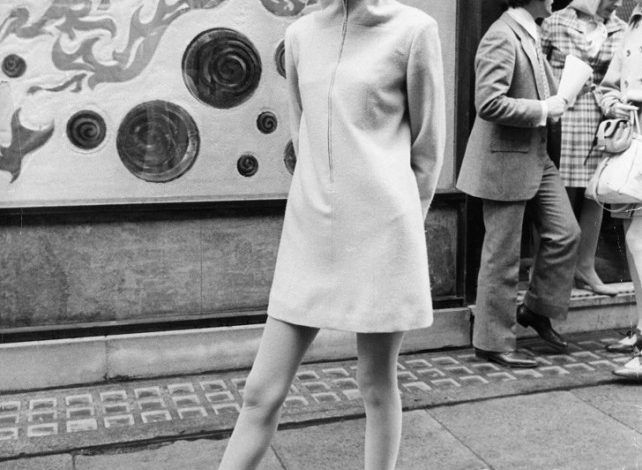
The short skirt revolutionized the fashion world in the 1960s, becoming a symbol of a generation and an essential part of a woman’s wardrobe. Today, skirt lengths can vary according to trends, but in the past, designers had a tough time—they had to fight for every centimeter.
5400-4700 BC.
Of course, women wore short clothing even before the 1960s. The first mentions of miniskirts appeared in Egypt—women wore them while exercising. Chinese chronicles depicted women wearing short skirts while doing housework.
1920s:
At the beginning of the last century, views on women’s clothing remained conservative, and short skirts were reserved exclusively for sports and dancing. However, actresses and dancers increasingly not only performed in short dresses but also appeared in them in public. Dancer Josephine Baker flaunted revealing outfits, and most fashionable women tried to emulate her.

1950s:
Since prudish society wasn’t yet ready for women in short skirts on the street, these skirts migrated to the big screen. Costume designers for the films “Trip to Mars” and “Forbidden Planet” weren’t afraid to dress their heroines in futuristic short dresses.

The first half of the 1960s.
This period influenced not only the history of fashion but also the history of women’s rights. André Courrèges and Mary Quant revealed women’s legs to the world and became heroes. Thus, swinging and freewheeling London became the birthplace of the miniskirt. Long queues formed outside the London Bazaar, and the whole of London was dazzled by the number of bare women’s legs. The model Twiggy, with her short hair and boyish figure, became a symbol of the era.
By the second half of the 1960s,
even former First Lady Jackie Kennedy was sporting a short skirt. And not just anywhere, but at her own wedding to Aristotle Onassis.  The fashion industry literally exploded with variations of the miniskirt. There wasn’t a single designer who didn’t include the miniskirt in their collections, from Yves Saint Laurent to Paco Rabanne.
1970s:
Let’s not forget that fashion is as fickle as the weather. Hardly had the miniskirt craze died down when the 1970s arrived, with their flared pants, midi skirts, and flowing dresses. Miniskirts migrated to the rock scene, where they looked more appropriate than on the runway.
In the 1980s,
cinema was actively competing for a place in the hearts of fashionistas. Each genre developed its own clothing conventions: slasher films featured cheerleaders in short uniforms, while romantic comedies featured heroines who somehow seduced their crushes with miniskirts. Furthermore, another bastion of popular culture—the music industry—took over the baton from cinema. In her music videos, Madonna chose the shortest skirts known to man. Or was it just a belt?

But then came the 1990s
, and the miniskirt became not just a popular item of clothing, but a marketing tool. Remember the film “Pretty Woman” with Julia Roberts and her ultra-short skirt and thigh-high boots—after the film’s release, everyone tried to copy that look. Don’t forget the legendary Britney Spears music video—Britney, in a short, pleated schoolgirl skirt, drove the public crazy.

21st Century: It’s hard to come up with anything new for the miniskirt these days: new variations appear on the catwalk, and miniskirts can be worn over pants or even dresses. But one thing remains constant: this wardrobe staple continues to help a woman look irresistible.
And that’s not all.
Here are a few countries where the skirt is considered a masculine attribute. And it’s not just Scotland we’re familiar with.
We’re all used to the idea that a man in a skirt is invariably Scottish. But it turns out that this garment is also worn by men in other countries. While the kilt is merely a national garment in Scotland, in some places, wearing skirts is mandatory in certain situations, and in some places, it’s even mandated by law.  It just so happens that men began wearing skirts much earlier than women, and for centuries, this particular piece of fabric worn around the waist has been a symbol of masculinity in various parts of the world. Today, this attitude towards this item of clothing is far from preserved everywhere, but there are 8 places on the planet where wearing a skirt will definitely not raise any questions.
Scotland. Kilt.
Naturally, a discussion of men’s skirts begins with Scotland. Today, you can wear a kilt without any problem in Edinburgh and Glasgow, and in other British cities, the Scottish national costume is also accepted without issue. Despite this, kilts are rarely worn—mostly at weddings and formal receptions. 
The Scottish kilt has a thousand-year history, and its pattern can reveal a man’s origins and clan. This garment is made of a checkered woolen material, now known as “tartan.” Technically, a kilt is the lower part of a larger kilt, a traveling blanket 5.5-6 meters long. A Scottish Highlander could, if necessary, wrap himself completely in such a piece of fabric.
Bhutan.
The gho robe, the official attire in Bhutan, is worn with knee-length socks and a special scarf called a kabni. The invention of this garment is attributed to Shabdrung Ngawang, who founded this mountain state in the 17th century. According to this statesman, the gho emphasizes the uniqueness of the Bhutanese people.

Wearing the gho is mandatory in many situations. In particular, all schoolchildren and government employees wear it. Putting on this garment is not easy, and not every adult man can manage it without assistance.
Burma. Paskhaw.
The traditional men’s garment in Burma, the paskhaw, is a piece of fabric 2 meters long and 0.8 meters wide. It is wrapped around the hips and tied in a knot at the stomach. Women’s skirts are similarly constructed, but are secured by tucking them at the side.  Paskhaws are made of cotton fabrics in subdued colors. This skirt is very comfortable and cool in the summer. If the hem gets in the way while working, it is passed between the legs and fastened to the waistband, creating improvised, loose shorts.
Morocco. Djellaba.
In Morocco, the long, hooded robe—the djellaba—is worn by both men and women. There are two types of this garment: the standard cotton version and the insulated wool version. The djellaba protects against cold, heat, wind, dampness, and even sand. 
It’s not uncommon to see Moroccans using the pointed hood of their robe as a bag. The color of the djellaba is chosen deliberately—white robes are worn for formal occasions, and if you see a man in a brown robe, you can be sure he’s single.
Fustanella. Greece.
As early as the 19th century, the fustanella skirt was a sign of exceptional masculinity. In Greece, this garment was an essential part of the military uniform for several centuries, and today it can be seen on the Evzones—guardsmen so popular among tourists during the changing of the guard. 
The fustanella’s design is quite complex. This double-layered wool skirt has 400 folds, each symbolizing a year spent under Ottoman rule. Incidentally, the Greek Guards iron their fustanellas themselves, and regulations require this to be done daily.
Islamic countries. Ihram
Hajj is a very important event in the life of every Muslim, and it requires a special wardrobe. Ihram is men’s clothing designed specifically for the pilgrimage to Mecca. It consists of two pieces of white cloth, one fastened around the waist and the other draped over the shoulders.

The main purpose of ihram is to demonstrate the unity of the faithful and their equality before Allah. In fact, it’s simply impossible to distinguish a beggar from a billionaire sheikh in the courtyard of the sacred Masjid al-Haram mosque.
Fiji. Sulu.
In the Fiji archipelago, men began wearing skirts relatively recently—in the 19th century, after British colonization. Before then, men on these fertile tropical islands went completely naked. The first to adopt the sulu were newly Christian islanders, who sought to distinguish themselves from the pagans.

Sulu skirts typically fall just below the knee, but ankle-length skirts are also permitted. The sulu is a mandatory uniform for the military, police, and schoolchildren. It is also a mandatory dress code in government buildings.
Japan. Hakama.
Today, hakama trousers can be seen in Japanese martial arts halls and museums, as well as during tea ceremony demonstrations. This ancient men’s garment appeared in the Land of the Rising Sun as early as the 6th century – like many other garments, it was imported from neighboring China.  The hakama has seven pleats, five in the front and two in the back. Some believe these numbers are taken from the samurai code of honor, representing the number of virtues, but more likely, this detail has a purely practical purpose, as it compensates for the different stride widths of the right and left feet. Folding the hakama along all the pleats without wrinkling is a true art that requires long and persistent practice.