The Strange Creation of the Architectural Genius Desert de Retz

The Desert de Retz , created between 1774 and 1789 by Monsieur de Monville, was one of the most famous places of its time. A wild mix of decorative pavilions and buildings with bizarre architectural elements made this place quite famous in its day. All the world’s rich and famous flocked to gaze upon this marvel. Today, unfortunately, it’s difficult to imagine the former glory of this estate and the paragon of perfection that was the Desert de Retz. A mad creation of the genius of architecture and landscape design, François de Monville.
François Racine de Monville was born in 1734. By the age of forty, he already owned vast estates in Chambourcy, on the edge of a 2,000-hectare forest, located approximately 15 km west of Paris. As an 18th-century French aristocrat with a significant passive income from his numerous landholdings in Normandy, Monville worried little about finances. He spent most of his free time learning new social skills and honing his many talents, which made him very popular in society and a welcome guest at the finest aristocratic homes.

A handsome and charming man, Monville danced so well that no ball was complete without him; he was always invited. He was an accomplished horseman, excelled in fencing, played the flute and harp, and was an excellent archer, “as skilled as an Indian.” But his talents truly found application in architecture and landscape design.

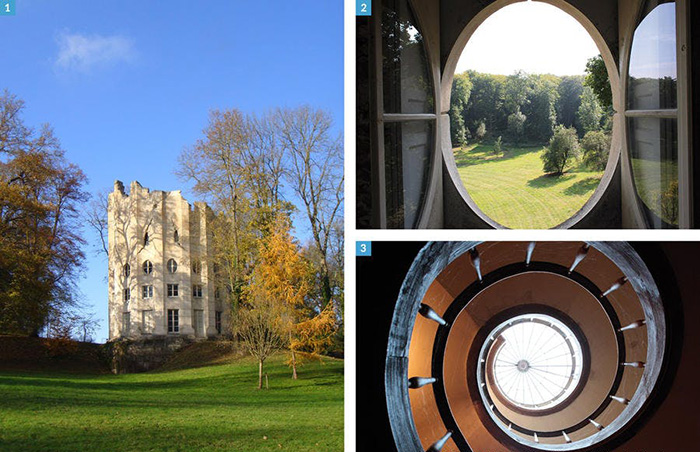
In particular, the famous summer house, resembling a column with round windows (by the way, does this house remind you of anything?). The column was originally built in ruins, with a spiral staircase running down its center, and living quarters located along the walls.


 It was during the off-season that the renowned photographer Michael Kenna, creator of meditative, twilight landscapes (Kenna, incidentally, studied at a Catholic monastery), photographed the Desert de Retz. Besides Michael, the garden was frequently visited throughout the 20th century by creative people and others, and surrealists flocked here in droves: Salvador Dalí, André Breton, Louis Aragon, Jean Cocteau… In 1923, the French director Abel Gance filmed his film “Help!” here.
The ruined column, up to 25 meters high in places, was the main residence of François de Monville.
Monville’s architectural virtuosity was fully demonstrated in the aforementioned estate, which the aristocrat purchased in 1774. Monville named it Désert de Retz. On this vast 40-hectare estate, Monville erected nearly two dozen structures, each representing a different period of human history. There was a Chinese-style house, a dilapidated Gothic church, a decaying Greek temple, an Egyptian pyramid, a Tatar tent, and an ice house.


 The very same Ice Pyramid. It’s called “ice” because it was used to store ice in the summer.
The most famous landmark is the House of the Broken Column, so named because it was shaped like a broken classical column. Inside the truncated structure is a spiral staircase leading up to five floors containing rooms for Monville’s visitors, although he himself preferred to stay in the much smaller Chinese House.


 An eccentric aristocrat created a beautiful garden, planting rare species of plants and trees, various fragrant herbs, and exotic flowers. A pond was dug in the garden, where the Island of Happiness was created.
  All this created an exquisite ambiance for the estate and served as an example of the impeccable taste of the owner and creator. François Racine de Monville drew all the sketches of the buildings and gardens himself. The young architect François Barbier was hired to carry out the actual work. The latter was expelled in disgrace after claiming to be the designer of the Ice Pyramid and demanding a review of his salary. Monville hired a simple designer, and the work continued.
  The project was meticulously developed and thought out down to the last detail. The design was designed with the utmost care to maintain harmony and create a sense of perspective and discovery. Standing in one place, we see only one object. Any visitor thus experiences a series of revelations, and the space appears much larger than it actually is. Only from the ruined column, upon entering and ascending, can a more significant portion of the property be seen.
A once-beautiful pond in the middle of the garden and the Isle of Happiness.
To the east of the estate, the Anglo-Chinese garden is the most beautiful and elegant part, with pavilions and temples, precious trees, and an open-air theater. To the west, the agricultural section includes a garden plot and a dairy farm, more rustic groves, as well as an obelisk, a hermitage, and a tomb.
At one time, Désert de Retz was visited by King Gustav III of Sweden, Marie Antoinette, Countess Barry, as well as Benjamin Franklin and Thomas Jefferson. One could visit the estate anonymously by purchasing a ticket.
When the Revolution broke out in France, Monville sold Désert de Retz with the intention of fleeing the country, but he did not leave. Perhaps the rapidly changing political landscape during the Revolution forced him to stay. In 1794, Monville was arrested and imprisoned after the Revolutionary Tribunal found the aristocrat guilty. He was released less than three months later, eight days after the execution of Maximilien Robespierre, which marked the end of the bloody Terror. Monville’s short stay in prison broke him both physically and mentally. He died three years later, at the age of 64, completely ill.

 These were once the ruins of a Gothic church.
  Ruins they were intended to be.
 The Temple of the God Pan


The Desert de Retz, with its scattered buildings, was classified as a historical monument by decree on April 9, 1941. It was added to the inventory by a decree on August 2, 1939. The garden was rediscovered in the 1950s by André Breton and his Surrealist friends. Since the mid-1980s, the Desert de Retz has undergone extensive restoration, returning part of the landscape to the state it was in during Monville’s time. In particular, the House of Columns has been meticulously restored.
 Several remarkable native trees, some 250 to 450 years old, have also been preserved.
 Much of what once stood on the estate has never been restored. It remains only in the sketch stage. The design has had to be reconstructed from fragments of ancient engravings. Of many structures, only ruins remain. Of the Chinese pavilion, only the foundation remains. Of the open-air theater, a rectangle on the ground and a Chinese cauldron in the corner. Of the temple of peace, two melancholy columns remain. Much of the former splendor has become just a memory…
Much has to be reconstructed from old engravings.