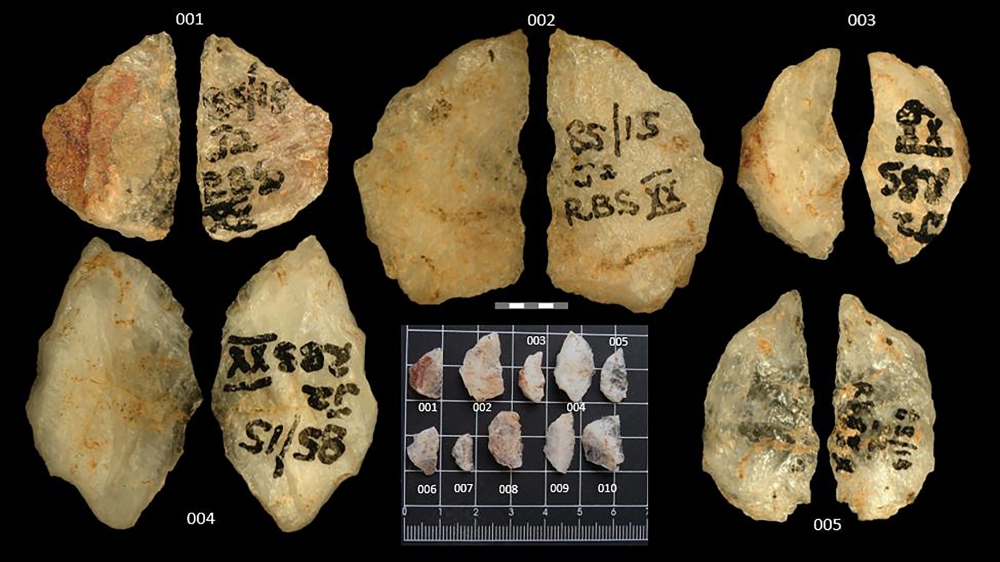
Today, it seems obvious: Dip a sharp object in a poisonous substance, and then use that weapon to take down your prey. But when did humans figure out this deadly strategy? A new study pushes back the timeline of this innovative hunting technique by tens of thousands of years.
Researchers led by Sven Isaksson, a professor of archaeological science at Stockholm University, have discovered poison residues on 60,000-year-old arrow tips unearthed in South Africa. With the next-oldest trace of poison use dated to 35,000 years ago, these tips preserve the earliest evidence of poisoned weapons by a wide margin. “It’s a big leap,” Isaksson said of the discovery, which was published in the journal Science Advances.
The finding reinforces existing evidence that early Homo sapiens possessed cognitive abilities comparable to those of our own. That’s because to tip an arrow with poison, hunters needed knowledge of local plants and their effects, as well as the ability to craft special weapons with the right dosages.
“It takes a developed working memory to be able to predict that if I put this arrowhead into that plant, it will shorten the delay before I get my hands on this meat,” Isaksson said.
Isaksson’s team examined specimens that were discovered in 1985 at the Umhlatuzana Rock Shelter in eastern South Africa. The shelter contains layers of archaeological remains that were left tens of thousands of years ago. The researchers were inspired to examine quartz arrow tips more closely that were lodged in sediments estimated to be 60,000 years old. — BECKY FERREIRA
This article originally appeared in The New York Times.