The Mastermind review: Josh O’Connor fumbles a museum heist in Kelly Reichardt’s intelligent drama

The Mastermind film review
Cast: Josh O’Connor, Alana Haim, John Magaro, Gaby Hoffman, Hope Davies, Bill Camp
Director: Kelly Reichardt
Star rating: ★★★.5
Time moves in the subtlest ways in Kelly Reichardt’s films. One of the foremost American filmmakers of this era, her films have a tough and tender observational style that never jolts us with action, but instead, the lack of it. There is nothing Hollywood-y about it. You look closely. From ‘Wendy and Lucy’ to ‘First Cow’, her compact character studies are evocative of a specific setting without shouting out loud.
The premise
In The Mastermind, which first premiered at the Cannes Film Festival earlier this year, Reichardt has managed to retain all of those qualities that made her work so beguiling, even as it is certainly the most narratively driven outing in her oeuvre. She situates the frame in 1970s Massachusetts to tell a heist story. This is a genre done to death by Hollywood, but in Reichardt’s confident and patient hands, this turns a genre inside out to situate a portrait of a rebel without a cause in the leading man. He is anything but a leading man, as we see how things turn out. His name is James Blaine Mooney, played wonderfully by Josh O’Connor.
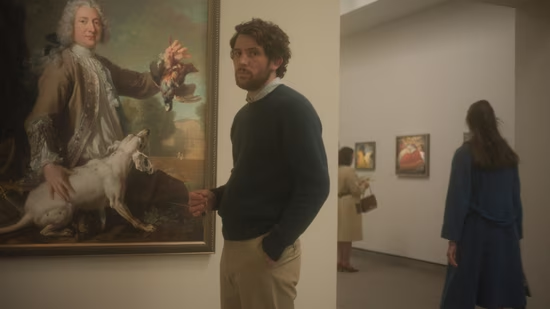
From the very first scene, Reichardt sets the tone. James steals a small artefact from the art gallery as his two talkative sons, Carl(Sterling Thompson) and Tommy (Jasper Thompson), roam around and talk constantly. His wife, Terri (Why is Alana Haim not given anything to do here?), is watchful but manages to get along. Perhaps she has given up the idea that her husband is up to any good. The problem is, James doesn’t think so, as he has a lot of things planned ahead. With the help of local goons, he sets in motion the theft of a quartet of paintings from the (fictional) Framingham Museum of Art.
What works
Collaborating again with Jonathan Raymond, Reichardt tells this story in her characteristic unaccentuated tone. The colour palette is cold and filled with daylight, even as the murky ordeals of a heist are taken forward with the quietude of a chamber drama. Rob Mazurek’s score is quite transfixing; the recurring jazz elements act like a jolt on the seriousness of it all. Mind you, this was the era before cameras and 24/7 surveillance, so just put on a silly face mask and go! James fails spectacularly, and the camera follows him as he attempts to make things work on the run. Josh occupies the frame with the sturdy awkwardness which uplifts many a scene. He is just a man-child at the end of the day and has never had to face the consequences of his actions. Until he is forced to.
Reichardt, a master filmmaker of quiet wisdom, takes this one man’s journey to paint an entire tapestry of a specific historical moment, in all its socio-political conflicts. The narcissist in James does not make him stand out from the rest; he cannot avoid the timeframe of anti-war demonstrations, the unrest that takes place in institutions and on picket lines, as dissent occurs in the same breath of his existence. He has his limits. The Mastermind is a political film in the realist, most gripping manner, which intends to knock its protagonist- and in extension, the viewer- sideways. One cannot run away.