The Thing With Feathers movie review: Even Benedict Cumberbatch can’t save this heavy-handed grief drama

Cast: Benedict Cumberbatch, Richard Boxall, Henry Boxall, Eric Lampaert
Director: Dylan Southern
Rating: ★★
Grief has long fascinated filmmakers, especially when it spills beyond the emotional and takes on a physical shape. From domestic nightmares to fantastical intrusions, cinema has repeatedly tried to give sorrow a body. Dylan Southern’s feature debut — The Thing With Feathers — enters this crowded space with admirable seriousness and a clear desire to unsettle, but despite its ambition and a ferociously committed central performance, the film often confuses emotional weight with sheer force.
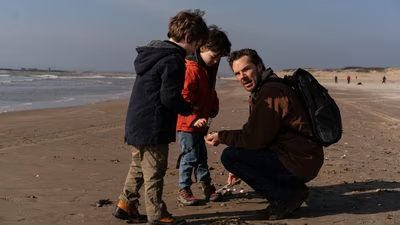
Adapted from Max Porter’s acclaimed novella Grief Is the Thing With Feathers, the story follows an unnamed London father (Benedict Cumberbatch) who has just lost his wife and is left to raise their two young sons alone. Still numb from the funeral, he forces himself through the motions of daily life—school runs, meals, work deadlines—while internally unravelling. His fragile equilibrium collapses when a towering, grotesque crow begins appearing in the house, provoking violence and insisting that it has come to help the family survive their grief. Whether this creature is a hallucination, a metaphor, or something more literal is left deliberately ambiguous, even as its presence becomes increasingly invasive.
The good
Benedict is the film’s emotional engine. He plays the widower with startling openness, allowing grief to register not just in breakdowns but in exhaustion, irritability and quiet disconnection. There is no vanity to the performance—only desperation. He captures the disorientation of sudden loss with painful clarity, especially in moments where he struggles to remain functional for his children. Visually, the film sustains a bleak, oppressive mood, and a handful of scenes between the father and the crow tap into a dark, biting humour that briefly sharpens the film’s edge.
The bad
The central metaphor quickly becomes suffocating. The crow, designed to embody grief’s cruelty, is so aggressively present that it leaves little room for emotional nuance. Its constant taunting and violence feel less revelatory and more repetitive. Dylan’s reliance on loud jump scares and emphatic musical cues further blunts the impact, making the film feel more assaultive than affecting. The two sons, despite capable performances, are thinly sketched, while the absent wife remains frustratingly undefined, reducing what should be an intimate loss to an abstract idea. The film wavers—too blunt for psychological drama, too restrained to function as effective horror.
The verdict
This is a film that takes grief seriously but expresses it clumsily. Its heart is in the right place, and Benedict’s performance alone makes it worth engaging with, yet the film’s insistence on externalising pain in such an overbearing way keeps viewers at a distance. Instead of inviting reflection, it often feels like it’s shouting its meaning. Sadly, for all its ambition, the film struggles to make viwers feel what it so desperately wants them to understand.