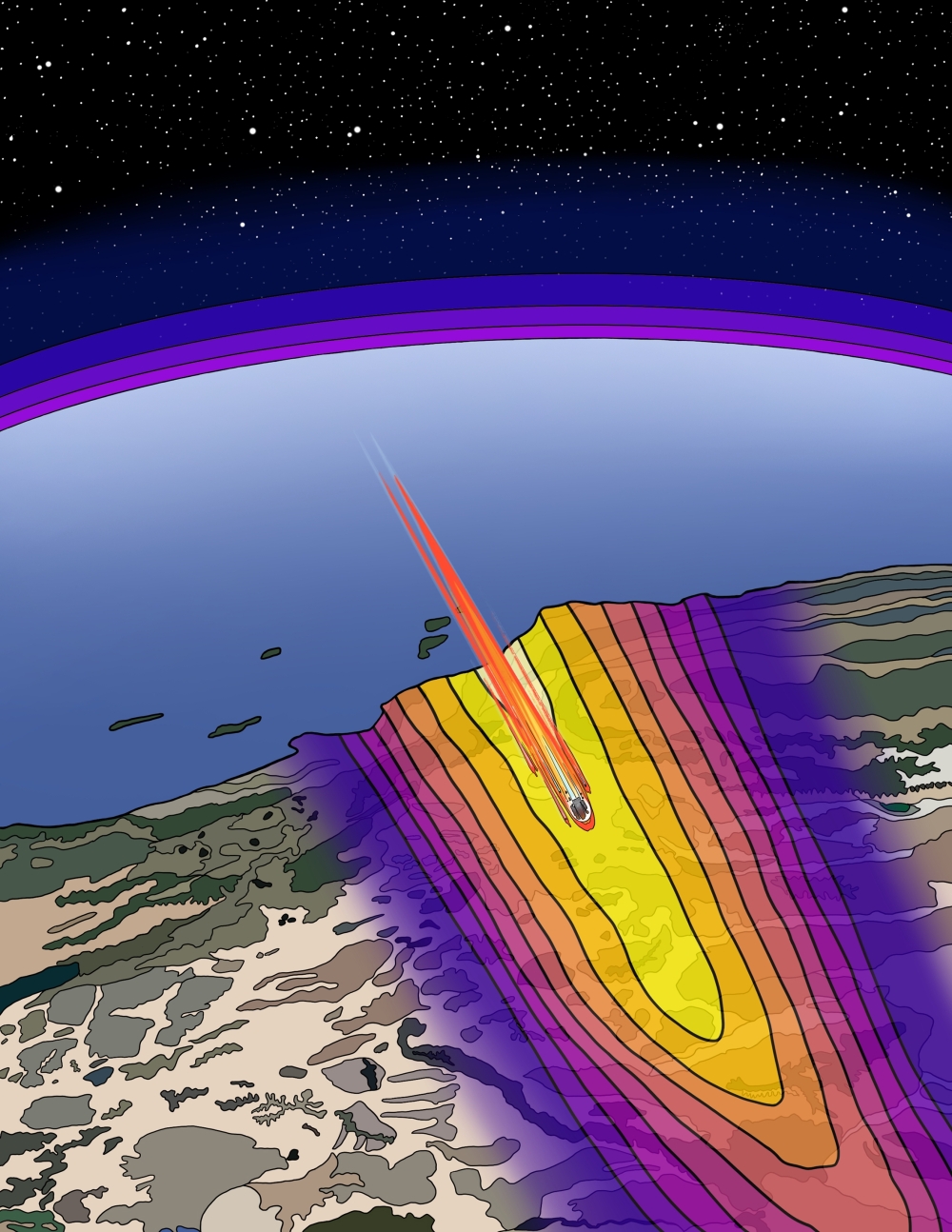
Large chunks of space junk that return to Earth at supersonic speeds are like artificial meteors, emitting sonic booms that shake the atmosphere before slamming into the ground.
That phenomenon gave Benjamin Fernando, a planetary seismologist at Johns Hopkins University, an idea after he saw footage of an unexpected and ominous fireworks display over Southern California on the night of April 2, 2024. Part of a spacecraft plunged uncontrollably through the atmosphere at hypersonic speeds before splitting into incandescent streams.
This pandemonium was made by a mission that ferried three astronauts to China’s Tiangong space station in 2022. During the spaceflight, the Shenzhou-15 spacecraft released its 3,300-pound orbital module. It was not designed to reenter the atmosphere, but a decaying orbit inadvertently brought the module back to Earth.
Tragedy was averted through sheer luck alone. Reentering space debris is often “moving so fast that there’s not a huge amount you can do about it,” Fernando said. The haphazard atmospheric reentry of the module would have caused fatalities had it struck a plane in the air or people on the ground.
But Fernando’s team showed it was possible to precisely map out the trajectory of an object as it reenters the atmosphere and to narrow down where surviving pieces may have fallen, thanks to seismometers, chiefly designed to detect earthquakes.
In a new study, the researchers showed that sensors throughout California registered the sonic booms of the Shenzhou-15 module’s disintegration. This data let the researchers ascertain how and when the spacecraft component broke apart, and in what direction the fragments were traveling.
Space debris can be toxic, flammable or radioactive, so finding it quickly before people come across it could save lives.
Finding out where space detritus ends up is troublesome. The U.S. Space Command tries to forecast reentry paths, but an object’s turbulent journey through the atmosphere can throw these calculations off — meaning that finding the hazardous matter can take weeks, if it ever is located.
Fernando thinks seismometers could solve this conundrum. Although primed to pick up the seismic waves of tectonic events, the tools can detect the rumblings of hurricanes, avalanches and megatsunamis. They also register the midair destruction of meteors, whose sonic waves strike the ground and create seismicity. The acoustic effects of reentering spacecraft parts aren’t too dissimilar.
The Shenzhou-15 module’s own sonic booms were detected by 124 instruments in the Southern California Seismic Network and by one station in Nevada. And by untangling the seismic spaghetti on each, the new study’s authors reconstructed the module’s terminal voyage. — ROBIN GEORGE ANDREWS
This article originally appeared in The New York Times.