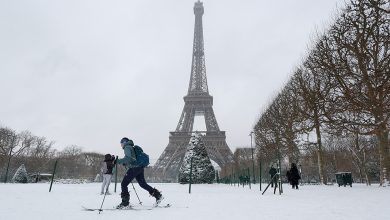
One of Europe’s major travel hubs canceled hundreds of flights this week and warned travelers to brace for more disruptions on Wednesday as winter weather and plunging temperatures across Northern Europe left crews battling days of accumulated ice and snow.
Nearly 2,000 flights have been canceled at Amsterdam Airport Schiphol this week, according to airport authorities and the flight-tracking website FlightAware — at least 700 on Monday, 500 on Tuesday and 600 on Wednesday. Officials said in a statement Tuesday afternoon that train service to and from the airport would be shut down until at least 6 p.m. Tuesday.
Wintry conditions were expected to continue from Tuesday evening into Wednesday, according to the Royal Netherlands Meteorological Institute.
Flights were also delayed in other European cities, leaving travelers in Germany, Belgium and elsewhere waiting at airports.
In Belgium, Brussels Airport warned that winter weather was likely to cause interruptions on Wednesday, explaining that “due to de-icing of aircraft and de-icing and snow clearance of runways and taxiways during the snowfall, we expect flight delays during the entire day.”
The city’s cobbled streets and cathedrals have already been coated in white for days, and snow showers were expected throughout the morning on Wednesday in Brussels, Paris, Antwerp, Belgium, and other metropolitan areas across Northern Europe.
Widespread winds were expected to continue through Thursday and Friday, potentially exacerbating treacherous conditions on roads.
On Tuesday, the weather agencies of France and the Netherlands issued orange alerts — their second-highest warnings on a three-tier scale — for Wednesday’s potential threats. Experts in the Netherlands suggested that some residents consider working from home on Wednesday to avoid travel risks.
“It will be slippery in many places,” they said.
While disruptive, this snow is not uncommon in this part of Europe — De Bilt in the Netherlands averages about 19 days of snowfall per year, according to its weather service. However, the frequency of snow days is decreasing due to more consistent winter temperatures that remain above freezing.
France’s weather service said the cold snap is among the most intense the country has experienced in at least eight years.
Residents there were still reeling from unexpectedly strong snowfalls on Monday, and local authorities were also preparing for more cold to hit the country overnight. French news media reported that five people had died in road accidents around the country.
France’s national weather service placed about a third of the country on high alert as more snowfall was expected Tuesday night, and the French interior ministry activated an emergency meeting.
Officials said school transportation would not run on Wednesday in several regions, including in areas around Paris, where the speed limit has been reduced to 70 kilometers per hour, or about 43 mph. “The region is prepared,” Valérie Pécresse, the head of the regional council of the Paris region, said in a TV interview. “The real problem is that these weather events often catch us by surprise.”
Philippe Tabarot, the French transportation minister, urged people to work from home if possible on Wednesday, and he said that authorities in several areas of France were banning heavy trucks from circulating.
Tabarot also told reporters at a news conference that about 40% of flights would be canceled at Charles de Gaulle Airport near Paris in the morning and early afternoon on Wednesday. A quarter of flights were to be canceled at Orly, the metro’s other main airport, on Wednesday morning, he added.
Traffic was completely halted at the airport of Nantes, in western France, France’s civil aviation authority said on social media.
By Thursday and Friday, a storm moving across southern Britain, named Storm Goretti, was expected to bring another round of potent winds to northern France. As the storm moves in, it will pull warmer weather into France, helping to thaw the region from this week’s brutal chill, the French weather agency said.
This article originally appeared in The New York Times.